
Overview
HipoCap consists of two main components:- HipoCap Shield - Multi-stage security analysis and governance
- Observability Platform - Tracing, evaluations, and monitoring (powered by Laminar)
HipoCap Shield currently supports Python only. The observability features use Laminar, which supports both Python and TypeScript, but the security analysis (Shield) is Python-only.
Architecture Diagram
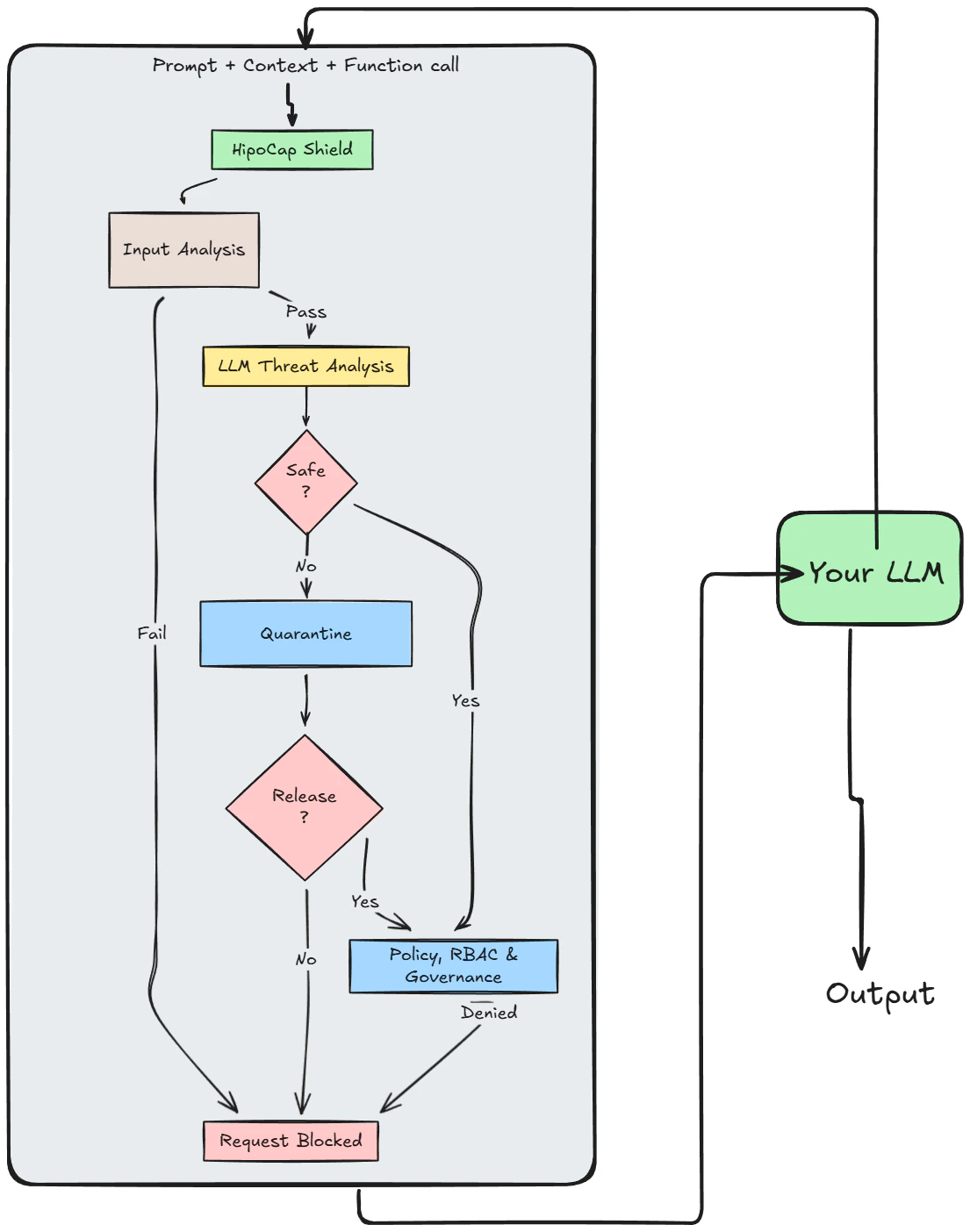
How It Works
1. Function Call Interception
When your AI application makes a function call (e.g.,send_email, search_web, execute_code), HipoCap Shield intercepts it before execution.
2. Multi-Stage Security Analysis
The Shield runs three stages of analysis:- Stage 1: Input Analysis - Uses Prompt Guard to detect malicious patterns in function inputs
- Stage 2: LLM Analysis - Analyzes function results for threat indicators (S1-S14 categories)
- Stage 3: Quarantine Analysis - Simulates infection by sending content to a quarantine LLM, then analyzes the output
3. Governance & RBAC
Before allowing function execution, HipoCap checks:- User roles and permissions
- Function-level access control
- Function chaining restrictions
- Severity-based rules
4. Decision Making
Based on the analysis, HipoCap makes one of three decisions:- ALLOW - Function call is safe to execute
- BLOCK - Function call is blocked due to security threat or policy violation
- REVIEW_REQUIRED - Requires human review before execution
5. Observability Integration
Whether the call is allowed or blocked, all activity is traced and recorded in the observability platform. This gives you:- Complete audit trail of security decisions
- Ability to analyze blocked attempts
- Performance metrics and cost tracking
- Full trace visibility for debugging
Key Benefits
- Security First - Threats are detected and blocked before execution
- Governance - Fine-grained control over who can call what functions
- Observability - Complete visibility into all AI operations
- Compliance - Audit trail for security and compliance requirements
- No Code Changes - Works with existing Laminar instrumentation
Next Steps
- Set up the Shield - Configure security analysis
- Configure RBAC - Set up role-based access control
- Start Tracing - Instrument your application